RafeeqMcGiveron.com
  • Home
  • My Writings
    • Novel: Student Body >
      • Student Body: Sample 1
      • Student Body: Sample 2
      • Student Body: Sample 3
      • Student Body: Sample 4
      • Student Body: Sample 5
      • Student Body: Sample 6
    • Literary Criticism and Reviews >
      • On Robert A. Heinlein
      • On Ray Bradbury
      • On Other Authors
      • Goodreads Reviews
    • Advising/Teaching, Etc.
    • Poetry
    • Memoir
    • The Bibliophile's Personal Library
    • Have You Ever Been to an Irishman's Shanty?
    • Letters from Gregory Road
  • Heinlein Cover Art
    • Pulp Magazines >
      • The Year of the Jackpot Manuscript
    • Earlier Adult Works
    • Scribner’s YA/Juveniles
    • Serialized Novels
    • Collections/Anthologies
    • Later Works
    • On Heinlein
  • Other SF Art
    • Big Illustrated Books >
      • Flights of Fancy
      • The History of SF
      • Science Fiction/Science Fact >
        • Children's
    • Vintage Hardcovers
    • Paperbacks, Etc.
    • Pulp Magazines
  • Blog
  • Links
    • In the News

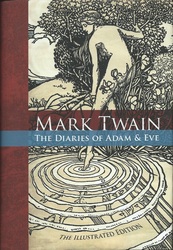
Review: Mark Twain, The Diaries of Adam and Eve

10/5/2014

0 Comments

 
Picture
I was told that Mark Twain’s The Diaries of Adam and Eve was going to be a swift and deliciously amusing read, and indeed it was—and yet it ended up being a little deeper than I had anticipated, and, by the end, actually touching.

Below is the wee review I did at Goodreads: https://www.goodreads.com/review/show/1072845438.

Rafeeq


Mark Twain's 1906 Diaries of Adam and Eve, with original early twentieth-century illustrations by F. Strothmann and Lester Ralph, is exquisitely witty, visually appealing, and even, by the end, touching.

The extracts from Adam's diary, which has each page of brief text paired with a gently humorous Strothmann illustration of a sometimes-broken tablet of a cartoon in rather Sumerian style, is sure to make many a beleaguered husband smile. Apparently jokes on the talkativeness of wives, the desirability of loafing on the weekend, and similar matters began around 4004 B.C. Really, though, it is all in good fun. And after the Fall, when Adam comes back from a trapping expedition on the north shore of the Erie, it is amusing indeed to see the clueless man's attempts at puzzling out exactly what is this strange little human-like creature that Eve claims to have found. Perhaps it is a fish, thinks he, and thus naturally he chucks it in the water to check--and yet for some reason Eve snatches the thing out most indignantly. From there on, it is a long, sleepless series of months...

Following Adam's diary extracts are Eve's, illustrated page by page with straightforward but charming woodcuts or engravings by Lester Ralph. In a nice twist, rather than remaining something of the butt of the joke, the former rib of the first diarist now comes into her own. Whereas in Adam's account she can come off as a pesky, unreasonable nuisance, Eve shows herself to be, although occasionally distracted, the emotional yin to Adam's unimaginative intellectual yang. In Adam's account, for example, when he tries to escape from "the new creature" and then, when found, simply leaves it out in the rain with water coming out of the holes it sees with rather than let it into his new shelter, the incident is presented as a minor though somewhat perplexing annoyance. In Eve's account, however, we now see actual human emotion rather than mere slapstick, and we begin to notice that simple male self-centeredness may not always be the most hilarious thing in the world.

Indeed, the growing maturation of the characters, deftly handled by the wry Twain, is an unexpected pleasure of this brief, easily read volume. Eve's musings on the nature of love, for example, are homely and touching, as is her final prayer that when death comes, it come first for her instead of Adam, "for he is strong, I am weak, I am not so necessary to him as he is to me--life without him would not be life; how could I endure it?" And yet just when we think the husband rather an unworthy clod, the final pair of pages, with an achingly solemn Lester Ralph illustration and a single heartfelt line from Adam, poignantly show that he has learned what it means to be human, too...

5 October 2014
0 Comments

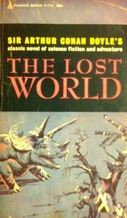
Review: Arthur Conan Doyle, The Lost World

9/1/2014

0 Comments

 
Picture
About a year and a half ago I picked up a 1963 Pyramid printing of Sir Arthur Conan Doyle’s 1912 The Lost World,  and I finally got around to reading ’er.

Really, it was quite a fun read.  Below is a review I did at Goodreads:
https://www.goodreads.com/review/show/1042538401.

Rafeeq


Sir Arthur Conan Doyle's 1912 The Lost World is, for its period, a very nice five-star adventure story. While the very beginning, with its seemingly conventional sentimental claptrap of competing for a lady's approval, is perhaps the weakest part of the tale, we soon get down to treacherous Amazonian jungles, conniving betrayals, and prehistoric beasts galore--and the close of the novel reveals that, as conventional sentimental claptrap goes, the author actually is a jolly good sport about poking mocking holes in it.

The tale begins when the narrator, Edward Malone, an Irish rugby champion and now earnest young reporter for the Daily Gazette, desireth for the purposes of marriage the hand of Miss Gladys Hungerton. This coolly superior icon of desirable young womanhood, however, is swayed neither by words nor by flowers but by deeds. Heroism is required, she preaches from the comfort of an English drawing room. Only a hero can win her, for only then can she be "what [she] should like to be,--envied for [her] man."

This may not be the deepest or most flattering thing a girl has ever told a suitor, but 'tis enough to send the love-struck newspaperman to attempt the closest thing he can to heroism: interviewing the imposing Professor Challenger. Challenger, after all, already has violently assaulted several who doubted his stories of finding during his most recent expedition to South America a seemingly inaccessible plateau in the depths of the jungle, along with the sketchbook of a dead American artist depicting pterodactyls and other Jurassic beasties. When the bristly Challenger speaks at the Zoological Institute, he of course is denounced as a charlatan, and it is agreed that a mission shall set out to the Amazon to prove orthodoxy still correct. Professor Summerlee, Challenger's most vociferous critic, calls for volunteers to join him, and Malone literally jumps to his feet, followed by adventurer and big-game hunter Lord Roxton. Miss Hungerton's suitor will have his heroism, apparently, or die trying.

Adventure ensues. Really, the standard travelogue of the deep Amazon, replete not only with danger but also with both beauty and wonder, is a fine read, and it is spiced with the amusing conflicts of the exquisitely arrogant Challenger and the equally determined, if more restrained, Summerlee. Once the explorers surmount the seemingly unclimbable plateau--and, naturally, are trapped upon it--we will see rookeries of huge pterodactyls, great iguanodons and freshwater sea monsters, unclassifiable dinosaurs like giant toads, and even savage "missing link" ape-men. That 1300 rounds of rifle ammunition listed in the supplies definitely will come in handy, eh, what?

This book is not necessarily the place to turn for modern paleontologic or evolutionary theory, of course, nor is it for modern race relations. The trope of "faithful Negro"--who calls his British employers "Massa," no less--versus sinister and sneaky "half-breed" is painful, but it should not be a surprise, given the time of writing. In terms of outmoded ideas, however, at least when what I might call something of the intellectual narrative frame closes, the notion of jousting for a fair lady's honor takes a lovely little drubbing.

Most importantly, though, despite occasional scientific or ethnographic shortcomings inherent to its era, The Lost World simply is a fun and entertaining adventure, and even more than a hundred years later it still remains well worth reading.

1 September 2014

0 Comments

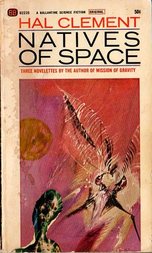
Review: Hal Clement, Natives of Space

8/25/2014

0 Comments

 
Picture
I just read Natives of Space by Hal Clement, which is actually a collection of three novelettes, one from 1946, one from ’43, and one from ’42.


It’s been quite a while since I’ve read, say, Eric Frank Russell’s Men, Martians, and Machines or A.E. Van Vogt’s The Voyage of the Space Beagle, but I found this maybe half a notch below what I remember those other two to be.  I seem to recall the Russell being a bit less serious, mind you, but for the adventure it was, it was just fine.

Still, this early Clement was indeed decent fun, and worth reading.  Below is the review I did at Goodreads:  
https://www.goodreads.com/review/show/1036418510?book_show_action=false


Natives of Space is a 1965 repackaging of three 1940s Hal Clement novelettes from, it appears by the Street and Smith copyrights, Astound Science-Fiction.

Assumption Unjustified of 1946 follows a pair of aquatic aliens who stop off on Earth to withdraw some blood--painlessly and carefully--from an unconscious Terran for use in a rejuvenation treatment. Mildly amusing attitudinal irony abounds, but the aliens' mistaken conclusion at the end is a whopper, and therefrom springs the title.

The 1943 Technical Error is one of those classic puzzle stories of the humans-must-figure-out-ancient-alien-technology variety. Here the only hope of spacemen marooned on an asteroid by the meltdown of their atomic motors is to make use of a seemingly inscrutable alien ship before their air runs out. It is good as far as it goes, but modern readers might the piece frustrating because the artifact, with its recognizable ion engines, electrical cables, and whatnot, simply isn't alienenough.

Impediment of 1942 returns to the third-person-alien point of view when telepathic moth-like creatures from a low-gravity planet must try to communicate with a human in hopes of finding on Earth the materials with which to replenish their ammunition supply so that they can return to their feudalistic, warring solar system. Clement's investigations on the biochemical nature of thought are interesting, but the notion that the human character, "like many people, involuntarily visualize[s] the written forms of the words he utter[s]" is a gimmick that seems completely divorced from reality...

So long as the reader understands that, despite its funky mid-1960s cover, Hal Clement's Natives of Space actually is a product of the simpler days of the pulp magazines circa 1942 to 1946, it can be considered a decent three- to four-star read. Rounding up a tad, I'll call it four.


24 August 2014

0 Comments

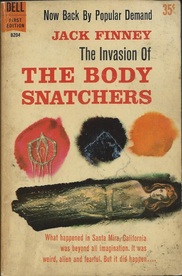
Review: Jack Finney, The Body Snatchers

8/24/2014

0 Comments

 
Picture
Some time ago at The Reading Place in Charlotte, Michigan, I picked up a nice 1963 Dell reprint of Jack Finney’s The Body Snatchers—no “invasion of” in the original title, apparently.  It was a marvelous read.

I cringed whenever the main characters ventured out of each other’s sight.  I frowned at their attempted rationalizations of the unbelievable things they had seen.  I gaped when, after finally having captured a cop’s service revolver, the protagonist ends up throwing it away because he cannot carry it inconspicuously—Come on, Doc, no jackets in 1955...?  Really, though, every sidestep and piece of self-doubt made perfect sense, and it simply set us up all the better for the time when the baddies trot out the fuller explanations.

In any event, below is the review I posted at Goodreads:
https://www.goodreads.com/review/show/1034719193


Jack Finney's 1955 The Body Snatchers is an exquisitely terrifying story of alien invasion which, despite the basics of its plot having become cultural tropes in the succeeding decades, remains as suspenseful as the day it was released.

Point of view, style, and setting here work together to make the unbelievable seem completely possible. First-person narrator Dr. Miles Bennell is the perfect character to deliver this story. The small-town doctor is well-educated, of course, and as a lifelong resident, he has the good general practicioner's eye for detail and tolerant understanding of human behavior, along with an intimate knowledge of the residents, geography, and history of the city of Santa Mira, California, population 3,890. His prose is matter-of-fact, sometimes wry, sometimes mildly self-deprecating, and when he begins by "warn[ing]" us that the tale "is full of loose ends and unanswered questions" and admitting that he "can't say [he] really know[s] what happened, or why, or just how it began, how it ended, or if it has ended," we are hooked.

The 1950s small-town setting then allows Finney both a nostalgic backward look and the firm grounding in prosaic reality needed by any good story of extraterrestrial invasion. The direct-dial telephone has been put in only within the previous year, for example, and the sexual tension between the divorced young physician and his divorced high school friend Becky Driscoll, with its mixture of amiable man-of-the-world roguishness and rather touching hesitance, is a subtly rendered portrait of early postwar mores. The familiar streets of the town, the back yards and porches where Miles played as a boy, the countryside where he hunted rabbits with a .22--in the warm sunlit day, all of these belie the seemingly impossible thing, human and yet not, that he and Becky see in the nighttime basement of the grim and frightened Jack and Theodora Belicec. Yet see it they did.

Finney here is a master of the night, and much of the action of the novel takes place after the comforting sun has set, in creepy basements lit by a single overhead bulb or by a dim penlight, on deserted roads where anything, anything at all, might wait in the dark beyond the headlights, in locked rooms where to sleep might mean to lose one's very self. Back and forth Finney deftly works us between the utterly shocking evidence seen firsthand at night and the sheepish uncertainty of plausible-seeming explanations in the morning. Clues are parceled out adroitly, and the protagonists' doubts, even as we wish to shake them into immediate understanding, are achingly believable. Yet eventually even these level-headed people must admit to themselves that something awful truly is going on, something inexplicable and threatening, a conspiracy that grows and grows, unseen and unsuspected by anyone but themselves.

The era of The Body Snatchers was, of course, ripe for such beautiful literary paranoia. Once the war had been won and the world apparently made safe for American ideals again, why, new threats suddenly lurked everywhere. The Berlin Blockade of 1948 brought American and Soviet armed forces to a precarious standoff in Occupied Europe, while the hugely populous former ally of China fell to Communism in 1949. Despite the testimony by General Leslie Groves, head of the Manhattan Project, that it would take the Soviets twenty years to develop the atom bomb, August 1949 saw this event, and the beginning of war in Korea in June 1950 seemed to many as if it may have been a feint to draw Western forces away from a forthcoming thrust in Europe.

Yes, Cold War sparring, Red spies, agitprop, suspicion--these helped prepare readers for The Body Snatchers, and of course for Robert A. Heinlein's 1951 The Puppet Masters, but Finney's novel does not have to be approached from this mindset. The book, after all, in its writing is as matter-of-fact as a Life magazine article, and the science-fictional notion of spores drifting slowly across interstellar space, from soon-to-be-ruined world to world to world, replacing one's most trusted friends and family with emotionless doppelgangers, is chilling. The Body Snatchers remains a top-notch, scaring read.

23 August 2014

0 Comments

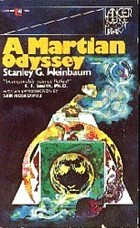
Review: Stanley G. Weinbaum, A Martian Odyssey

8/17/2014

0 Comments

 
Picture
Stanley G. Weinbaum’s A Martian Odyssey, with its title story’s colorful depiction of the strange, affably amusing, and yet ultimately enigmatic Tweel, is something that readers always hear about from the critics, historians, and fellow authors of science fiction.  Perhaps we nod, or shrug, or think Hmm...  Certainly I had never read the thing, though I have been reading SF for over 35 years and have read a boatload of references to it.


I had indeed picked up a copy in the last year or two, one with one of those distinctive semi-psychedelic covers of the early 1970s, so at last I read the book, and it was really quite good for the mid-1930s, with only one of the five stories being ho-hum.  The others were entertaining and imaginative, and, actually, the introduction by Sam Moskowitz was helpful as well.

Below is the review I did at Goodreads: https://www.goodreads.com/review/show/1028584906.

Rafeeq


A Martian Odyssey by Stanley G. Weinbaum has some of the occasional creakiness to be expected of Golden Age science fiction--conventions of the era, really, rather than actual true authorial failures--but for its period of the mid-1930s this book of five stories does indeed show a great deal of innovative imagination, and of course quite decent storytelling as well.

The title story, the 1934 "A Martian Odyssey," is one of those original "classics" about which the SF reader always hears, such as, say, John W. Campbell's "Who Goes There?" or Robert A. Heinlein's "By His Bootstraps" or Isaac Asimov's "Nightfall." Having read the Weinbaum at last, I confess to considering it perhaps a half-notch below these others, but as Sam Moskowitz reminds us in his introduction, it does indeed bring some subtle and mature thinking into the pulp magazines.

On the one hand, the breezy first-person narrative with the occasional interjections from shipmates with cutesy German or French accents is not exactly James Joyce's Ulysses, and while I like otherness as much as the next fellow, the habit of ostrich-like Martian "Tweel" of jumping high in the air to land literally, cartoon-wise, head-first with his beak in the sand seems just too damned cute as well. But Weinbaum's careful and persistent depiction of the creature as being not just as intelligent and as noble as a human but even more so is well worth the read. Tweel is sometimes comic, and often inscrutable, but he is a true character rather than a cardboard cutout; his riddle may not be solved in this tale, but it suggests that the universe, even the smallish part reachable by Golden Age rocketships, contains both wonder and humbling mystery aplenty. And when the deeply affected narrator, having been saved from death a couple of times by this completely alien thing, shows that he is not simply a "native" to gawk at or look down upon, we find something very modern, worthwhile, and even touching.

The book's second story, "The Adaptive Ultimate" of 1935, has Frankensteinian overtones as a biochemist develops a serum that, presumably by benign genetic mutation, increases an organism's "adaptation" such that disease and injury can be repaired in mammals with the ease of a severed flatworm turning into two creatures. When a young woman almost dead of tuberculosis is injected, she is cured in days, but the adaptation goes farther than ever could have been imagined. The drab and almost penniless young woman becomes, very subtly, beautiful and self-assured and calculating...and uninterested in mere morals that could get in the way of her own survival. She can out-think and out-charm any man--perhaps ensnare is the better word--and because her body now can heal even knife wounds or gunshots instantaneously, she seems unstoppable as she maneuvers politicians toward another world war that somehow will leave her as, essentially, empress of the world. When reduced to these outlines, it may sound silly, but the story is really quite decent indeed.

"The Lotus Eaters" of 1935, which follows the Venusian honeymoon/exploring expedition of a female biologist and a male engineer, is even more dated in terms of planetology and xenobiology than is "A Martian Odyssey," but its creatures are just fine for the era, and the writing is arguably better than that of the title story, too. Again Weinbaum brings in new and unusual, even unsettling, ideas. If a newly discovered yet infinitely weary and almost extinct colony of Venusian plants, for example, is shown to be far superior to humans in intelligence and knowledge...well, how does this affect the mindset of the hairless ape of Sol III as it clambers via rocketship from its own jungles into those other worlds? There is something grandly melancholy in the dying-off of this weird species of semi-mobile plants that have no individuality, no drive, no will for survival, but which, termed godlike by the deeply sobered explorers, know more than ever can be communicated to the newcomers, let alone explained.

"Proteus Island," first published in 1936, returns to the genetic interests of "The Adaptive Ultimate" when a zoologist exploring an isolated Australasian island finds that since the last mariner's visit of just a couple of decades earlier, evolution seems to have run completely and unbelievably wild: of all the strange plants and animals, not a single one is like another--no species has more than one member. Again there is a "girl," and again there is an attraction the protagonist tries to resist, but here the girl ends up being more the solution than the problem. The scientist's high-handed attitude toward his Maori boatmen grates even for the 1930s, but the puzzle is indeed fascinating, and it is solved, at least given the science of the era, fairly believably.

And about the book's final chapter, "The Brink of Infinity" from 1936...really, it is a comparative throwaway, a piece about a mathematician abducted by a crazed chemist who, by using what is basically a "What number am I thinking of?" game, gets back at the profession whose member crippled him with a miscalculation. Now, that is a pulp story. It is not actually even science fiction either, nor would it necessarily be out of place in the mimeographed newsletter of some old high school math club.

Notwithstanding the dully echoing kerplunk of its last story, Stanley G. Weinbaum's A Martian Odyssey remains an interesting four-star read for anyone exploring the Golden Age origins of the mutants, the extraterrestrial landscapes, and the remote and inexplicable alien intelligences that have come down through countless 1950s movies, now-familiar Star Trekepisodes, and on into the futures of the present.


16 August 2014

0 Comments

Review: Anthony Boucher, Rocket to the Morgue

8/10/2014

1 Comment

 
Picture
I was waiting for what seemed like forever for a copy of Anthony Boucher’s Rocket to the Morgue to arrive.  I don’t really know much at all about mysteries or detective stories, and I haven’t even read Arthur Conan Doyle’s Sherlock Holmes in a good quarter century or more, though I do happen to be very fond of the Jeremy Brett portrayal from the ’80s and ’90s.  I had heard, however, that Robert Heinlein was one of the murder suspects, so I figured it would be at least passably interesting.  Well, that old 1967 paperback reprint came at last, and it was indeed an exceedingly fun read.

Below, therefore, is the review I did at Goodreads:
https://www.goodreads.com/review/show/1022796955.

Rafeeq


Anthony Boucher's Rocket to the Morgue is an ingenious mystery and also a particular delight to anyone interested in the "pulp" era of science fiction.

The novel opens in prewar Los Angeles with Lieutenant Terrance Marshall, amiable family man and homicide detective, feeding the baby and answering his wife's question of "Anything interesting happen today?" Nothing interesting, of course--just a ho-hum corpse dead of low-caliber lead poisoning in a flophouse...only the murderer has not bothered to take the $300 of 1941 cash from the room, while the dead man's jacket holds an oddly distinctive rosary and the telephone number to a "[v]eddy veddy swank" apartment hotel. While Marshall's mystery-minded friend, Sister Ursula, looks into the singular religious artifact, the Lieutenant's investigation of the apartment hotel leads by complete happenstance to the plump, pretentious Hilary Foulkes, heir to his very famous father's literary estate, and a man thoroughly disliked by several science fiction writers. Now, Foulkes just happens to have had a couple of odd close calls recently--a falling brick, then a box of poisoned chocolates--and during Marshall's interview there arrives a package that ticks loudly, so...

Well, as one can see, pleasant tangles and red herrings abound. There are professional jealousies and monopolistic squeezings, a glamorous Mrs. Foulkes with little love lost, a brother-in-law who is next in line as literary executor of the lucrative "Dr. Derringer" series, a deferential cousin/typist, and a classic locked room mystery. For amusement we have sentences of the droll "She crossed her legs (she knew they were good) and leaned forward (she knew they were good too)" variety, a promotion-seeking flatfoot from Pasadena, installments of an exquisitely awful space opera being hacked out at a penny a word, and the wry wit and wisdom of the Manana Literary Society.

Boucher's depiction of this real-life group of California fantasy and science fiction writers, with its scarcely disguised members such as Robert A. Heinlein and others, is a particular joy. Each of these fellers, of course, has a perfectly acceptable reason for not necessarily relishing the continued corporeal existence of the vain and penny-pinching Hilary Foulkes, but it is the combination of pontificating about the history, future, and meaning of speculative fiction, plus numerous in-jokes, that make them doubly worthwhile. Austin Carter, for example, the Heinlein character, is suave and talkative and completely unflappable; when he says to Lieutenant Marshall something that it seems only the attempted murderer could have known, he then shrugs to the sputtering man, "'I believe I am supposed at this point to light a cigaret nonchalantly? Very well, I hereby do so.' The flame of the match was steady in his hand." This is hard not to adore.

Even if one were not already familiar with the lovable cranks of the quirky real-world Manana Literary Society--and I confess to knowing exceedingly little about anyone except Heinlein--all of these factors add up to a very enjoyable five-star mystery from the pulp era of science fiction. In addition to the occasional wisecracks and the literary history and the in-jokes, there really is a mystery here, and its unexpected solving is definitely worth the wait.

10 August 2014

1 Comment

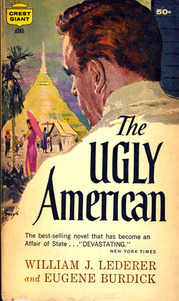
Review: Lederer and Burdick, The Ugly American

8/4/2014

0 Comments

 
Picture
When I finally scored a copy of The Man in the Gray Flannel Suit last week, I also picked up, from the very same twirly-rack, a nice old 1961 copy of The Ugly American by William J. Lederer and Eugene Burdick—the latter of whom was co-author of Fail-Safe, by the way.  Anyhoo, this was a real ‘50s find, something that could have been improved only by bumping it up to a trifecta had there also been a copy of, say, Grace Metalious‘ Peyton Place, which there unfortunately was not...

Lederer and Burdick were, in their geopolitical context, a solid 5-star read, so I did a review on Goodreads
https://www.goodreads.com/review/show/1016746356, copy-pasted below.

Rafeeq


The Ugly American by William J. Lederer and Eugene Burdick is lifelike and rich, a sometimes wry and ironic panorama of the mid-1950s ideological and military front lines of the Cold War drawn, we are informed in the Epilogue, often almost directly from the authors' own experiences in Southeast Asia. Though it thus is fictionalized, the book--I would not quite call it a novel, really, as the characters are so disparate, and only a few of them turn up here and there throughout--reads with the veracity of a diary or a journalistic account. Sometimes the events and characters portrayed are cringe-worthy in the extreme, but we know very well that such arrogance, such blindness, such bombastic buffoonery were far from uncommon; indeed, the Epilogue explains, point by point, exactly how close certain little anecdotes are to the truth.

The back cover of my 1961 Fawcett Crest edition of the book asks, in boldface type, "Is President Kennedy's 'PEACE CORPS' The answer to the problem raised by this book?" Perhaps so. Certainly the colonial French and the American diplomats who didn't bother learning the language or culture of the region did not seem to do much to keep the dominoes from toppling. While Lederer and Burdick do not appear to have noticed the long-term damage done by United States support of any ol' dictator so long as he was anti-Communist, and by shenanigans such as the U.S.-orchestrated coups in places such as Iran and Guatemala, they on the other hand probably do not exaggerate the dirty tricks and the viciousness of the other side.

It would have been interesting to explore a little more deeply exactly what, aside from legitimate anti-colonial sentiment and ginned-up anti-Western propaganda, motivated the average Communist guerrilla. Perhaps, though, this is a bit much to ask of a piece published so soon after the fall of besieged Dien Bien Phu, when it urgently appeared that with the right kind of effort, shoring up Indochina would prevent the fall of further nations all the way back to Africa. The authors do, however, at least show with care the motivations of a disparate host of well-meaning and motivated characters on this side of the Bamboo Curtain, whether religious or military men or idealistic rather than opportunistic diplomats, trying their best to help free peoples live as they themselves choose. Could these amiable folks willing to live in the boondocks, eat the food, learn the language, and share and communicate instead of impose from above really make a difference? Very possibly, at least when measure by goodwill on the ground rather than by the speeches in the national capital; with luck, they at least can help offset the damage of the stuffed shirts and the fools.

Lederer and Burdick's vivid snapshot from the height of East-West sparring, when the Soviet occupation of Eastern Europe, the Berlin Blockade, the fall of China, and the bloody Korean War were threats seen in contemporary headlines rather than mere chapters in a history textbook, is politically dated, of course. The places the authors wrote about, the seemingly clear-cut ideologies, the pressing national issues--such things now have been settled decades ago. Nevertheless, The Ugly American reminds us, long after the brushfire conflicts of the Cold War have burned out, of the fundamental human values of courage, respect, and friendship, whose worth certainly does not diminish.

4 August 2014

0 Comments

Review: Sloan Wilson, The Man in the Gray Flannel Suit

7/28/2014

0 Comments

 
Picture
Having seen the film a number of times, I had wanted to read The Man in the Gray Flannel suit, but I hadn’t happened to run across a copy until a couple of days ago.  The movie is very good for its era, and of course the novel is even better.

Below is the review I did on Goodreads:
https://www.goodreads.com/review/show/1009625789.

Rafeeq


Whenever I watch The Man in the Gray Flannel Suit with Gregory Peck, I say, "Boy, it'd be nice to read the original novel by Sloan Wilson sometime, wouldn't it?"...and when I at last came across an old 1956 printing in the local library basement sale, this old paperback shouldered its way immediately to the top of my reading list. I was not disappointed. It is an enjoyable and moving five-star work.

The basics of the novel--a combat veteran haunted by memories of the men he killed, and by the brief, desperate love he found in Italy, tries to turn his mousy career and his dispirited marriage around by joining the "rat race"--are familiar to anyone who has seen the film, so there is little need to cover them here. The novel, of course, is more finely grained in its telling detail than any film, and such detail is lifelike and good, and ultimately moving.

On the one hand, Wilson's narrative voice can be urbane and gently wry. After spending most of the first page describing a question-mark-shaped crack in the wall of the couple's dingy house, for example, the text reports with calm irony that this suspicious shape "d[oes] not seem symbolic to Tom and Betty, nor even amusing"--and in case we still don't get it, another nudge points out that everyone else cannot help staring at the thing. Sentences of the offhand "It was fashionable that summer to be cynical about one's employers..." variety are a similar joy.

Coupled with such minor authorial games, however, is a rich investigation of the mind of ex-paratrooper and now vaguely wary husband Tom Rath. During the Second World War, in close combat, Rath killed seventeen men--a fact "he simply hadn't thought about for quite a few years" rather than "a thing he had deliberately tried to forget." Mm hmm. And yet, as he thinks of those years, "His mind [goes] blank. Suddenly the word 'Maria' flashe[s] into it"...and yet, at least this early on, all we will get is that single word, and then the narrative tacks intriguingly away.

Wilson will give more in due time, of course. He will show us Rath's bleak fatalism of December '44, when after two years of fighting in Europe his unit is to be sent to the Pacific, and he knows--knows--that his luck will run out, and in another jump, or two at the most, he will be dead. The future he will never see, the cold beer he will never drink, the rare steaks he will never eat, the lovely wife waiting at home, to whom he will never make love again--they do not seem real, while only the vulnerable and passionate Maria makes life at all palatable. And of course, just before shipping out to the Pacific Theater, he learns that there may be a child...

The friend killed by Rath's grenade, the unacknowledged longing for Maria and his abandoned child, his own absent father shell-shocked in the First World War and then likely suicided in the '20s, the ancient grandmother with her tales of family glory, the faithful wife who wants to see him happy and successful--the introspective Tom Rath is pushed and pulled by impetuses he struggles to understand. And if he is to start living again, truly living, he will have to face the truth, as he has been avoiding for so long.

Is the ending a little too pat? Perhaps. Certainly Betty Rath, after a revelation that could indeed finish many a marriage, ends up being an astoundingly good sport about it. Would Tom be as forgiving, one might wonder, if Betty, as convinced as he had been of his imminent death, had found comfort as he did in Rome? Maybe at this stage of the novel he might. Wilson does not quite raise the question, however--unfortunate, as even a few lines would be worthwhile.

Nevertheless, the conclusion may indeed be believable. Betty Rath, after all, begins to realize that she has never had a clue about even a tenth of what the man sleeping beside her all these years has suffered, and her sympathy is touching, as are her husband's final simple and heartfelt, almost awestruck professions of love. Tom Rath in the end has nothing to hide, and for the first time in years he feels not cynical and bitter but happy, within himself and within his marriage. After delving so believably into the mind of a privileged college boy turned killer, then turned corporate drone, and finally turned balanced human being, Sloan Wilson brings The Man in the Gray Flannel Suit to a conclusion that is life-affirming and even heartwarming.

28 July 2014

0 Comments

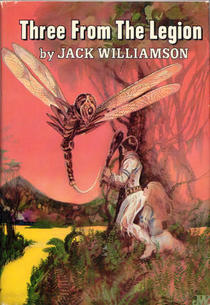
Review: Jack Williamson, Three from the Legion

7/16/2014

0 Comments

 
Picture
I just finished the last of Jack Williamson’s Three from the Legion omnibus yesterday, and today I posted a review at Goodreads:
https://www.goodreads.com/review/show/998322353?book_show_action=false .

Really, each succeeding novel was better than the last, and while the first book was published in 1935, the third dated from 1950, and the final novella tucked in at the end of that was actually 1967, so by the end we were reading much more mature and modern work.

Rafeeq


Having already written a review of The Legion of Space
https://www.goodreads.com/review/show... before realizing that this novel also is collected in Three from the Legion, now I will finish up with the full omnibus trilogy.

Although I had harped on some nagging features of the first Legion novel, the following works in the series struck me as noticeably better, which was a pleasant surprise. Yes, we are still reading space opera from the Golden Age of science fiction, so good is good, and bad is bad, with non-humans such as aliens from outside the Solar System or mad-scientist-created androids being the latter, and the flinty-eyed, usually tall officers of the mighty Legion of Space guarding the former. Fair enough for the genre. Still, the characters and the points of view brought by these succeeding books pull a series that began for me in the two-to-three star region into the neighborhood of more like four stars.

Whereas John Star of The Legion of Space (1935) does not seem very well developed, even for the 1930s, his son, Bob Star, the protagonist of The Cometeers (1936), is more conflicted, more human, and hence more interesting. Bob is young and very capable, but he is less sure of himself than was his father at that age, and secretly vulnerable. In striving to beat the grades of the number-one student at the Academy, an upperclassman who has it out for Bob and hazes him mercilessly, the boy has worked himself to the edge of a nervous breakdown. Now after graduation his parents have tried to keep him at home, shielded from the peculiar news brewing at the edge of the Solar System, so that he might rest up before receiving his first space assignment. Such treatment galls...and the throbbing beneath the scar on his forehead, a reminder of the torture--literal torture--of rival Stephen Orco never goes away either. Still, when a strange green comet-like object sails in from interstellar space like a dreadnought, the youngster at last will have the chance to prove himself--oh, yes, and save the Solar System and find himself a girlfriend, too.

When Williamson revisits the series almost a decade and a half later in One against the Legion (1950), the protagonist is another firm-jawed young officer aching for his first assignment, only here the youngster is framed for murder and the theft of a top-secret device, and he is imprisoned, convicted as a traitor, and even tortured by Legion interrogators before finally escaping. This time, therefore, the once-infallible Legion of Space is fallible indeed, and as the deeply wronged Chan Derron tries to find out why a super-criminal calling himself the Basilisk is framing him for crime after crime, he will have to get to the bottom of another threat to all humanity.

Finally, although Nowhere Near (1967) is listed as being part of One against the Legion, it is a completely separate novella, taking place years after and light years away from the previous tales. This one is told in first-person point of view rather the sometimes-pompous third person, and it is...well, let us say a decade and a half more sophisticated. Cosmological speculations on the age of the universe and whatnot happen to be rather dated now, but the piece is so much more modern and subtle than even the 1950 book. The narrator, the commander of a space station near a strange spacetime anomaly, is experienced and a little weary, and he is not immediately swept to breathless admiration by the waddling entrance of the Giles Habibula, the now-famous gourmand/lockpick/incipient alky of the previous novels, nor even by the flourishing of the name of the distinguished Star family. And when some grizzled-veteran-meets-girl occurs, even that is made almost tolerable by its less cliched execution.

While the first installment of the Legion of Space saga does not age especially well, the following works get better and better, slowly shedding their histrionics across the decades, and even growing quite palatable indeed. I only wish Williamson had not begun the series with a "found manuscript" narrative frame that he then seems to forget and never close...

16 July 2014

0 Comments

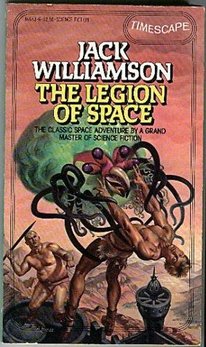
Review: Jack Williamson, The Legion of Space

7/14/2014

0 Comments

 
Picture
Oops, just realized that although about a week ago I did a review of Jack Williamson’s old The Legion of Space on Goodreads
https://www.goodreads.com/review/show/988149834?book_show_action=false, I apparently forgot to cross-post it to my blog, which is a tad sloppy.  Therefore, now that I am almost done with the final book in the trilogy, and hence on the verge of posting another review, here, belatedly, comes this ’un.

Rafeeq


Jack Williamson's The Legion of Space is an interesting artifact the Golden Age of science fiction, copyrighted in 1935 and then tweaked after the war with its twentieth-century narrative frame now mentioning Pearl Harbor. It is definitely an acquired taste, though. If this novel were the work of a modern author...well, the thing simply would not be publishable, as if Norman Spinrad's The Iron Dream, by Adolf Hitler had been stripped of irony and self-awareness; call that, at most, one star. From the perspective of the mid-1930s, though, presumably it would be a four- or perhaps five-star book...in the category of "science fiction space opera," of course. For a science fiction buff whose readings have included the old stuff, let us call it now two or three stars, rounding up on general principle.

The story is pure adventure, at a breakneck pace, with short little chapters ending with a cliffhanger. I do not fault it for that--such is the genre, and even quaint oddities such as future fortresses with medieval-style walls, alien jails whose completely mechanical locks can be picked by Earthlings, awe-inspiring buildings whose dimensions usually come in increments of thousands of feet, and whatnot do not detract too much. The voice of the narrative, however, is a little harder to swallow: a simple third-person point of view that is big on superlative descriptors of the external world while dipping into the inner mind of the protagonist somewhat perfunctorily. Again, though, that is the 1930s.

What grated a bit for me was the utter simpleness of worldview. Good is good, and bad is bad, and while there may indeed be truth in that, too often such things were just painfully obvious. The man who would overthrow democracy and reinstate a monarchy, with himself as Emperor of the Sun, for example, seems a baddie from the moment he steps onstage, wearing makeup bold enough to be read even by viewers in the last row. This distant relative of the protagonist is effeminate and haughty, possessed of "insolent pride" and a "[r]etreating chin and irresolute mouth betray[ing] the man's fatal weakness"--all of this given in five ex cathedra lines predating by three decades the "Show; don't tell" admonition of countless creative writing professors. When the protagonist ignores his shiver of unease and instead tells himself that he should not doubt this superior officer of the Legion of Space--who is attended, by the way, by one trooper described as ratlike and another described as wolfish--this gives us less complexity than an awkward and cringe-worthy moment. How, after all, did he miss the urgent piano music and the mustachios being twirled?

The giant jellywish-like alien invaders are evil, as apparently can be apprehended at first glance. The "girl" who guards the secret of the ultimate weapon that has kept the peace of the Solar System is slim and beautiful, and naturally the protagonist falls--without, of course, ever consciously putting a name on it until the end--in love with her at their first meeting. One of his companions-to-be is a calm and quiet-voiced leader, one is hugely muscled, and one is an obese gourmand goldbrick always bemoaning, comic-relief-wise, his pathetic fate, and calling for another meal, another nap, or another bottle of wine...oh, yes, but he happens to be a top-notch locksmith and spaceship engineman, too. Even the protagonist's other distant relative, the one who arranged for the square-jawed fellow to serve under the baddie, is precisely what he seems, right down to the redeeming qualities that were obvious even when he seemed a traitor to all that was good and right.

Such carping out of the way, however, The Legion of Space is at least a decent book, so long as the reader understands that it comes from an era almost 80 years removed, from the heyday of pulp fiction. It is fun--it really is--if approached in the right frame of mind.

6 July 2014

0 Comments
<<Previous
Forward>>

    Author

    Author of several dozen pieces of literary criticism, reference entries, and reviews; novel Student Body; memoir Tiger Hunts, Thunder Bay, and Treasure Chests; how-to The Bibliophile's Personal Library; humorous Have You Ever Been to an Irishman's Shanty?​; some poetry; and quite a bit of advising/Banner training materials.

    Archives

    May 2025
    August 2024
    May 2024
    November 2023
    November 2022
    October 2022
    September 2022
    January 2022
    December 2021
    July 2021
    July 2020
    June 2020
    May 2020
    February 2020
    September 2019
    March 2019
    January 2019
    December 2018
    November 2018
    August 2018
    June 2018
    November 2017
    July 2017
    June 2017
    May 2017
    April 2017
    March 2017
    February 2017
    January 2017
    December 2016
    November 2016
    July 2016
    May 2016
    February 2016
    January 2016
    December 2015
    November 2015
    October 2015
    September 2015
    August 2015
    July 2015
    May 2015
    April 2015
    March 2015
    February 2015
    January 2015
    December 2014
    November 2014
    October 2014
    September 2014
    August 2014
    July 2014
    June 2014
    May 2014
    April 2014
    March 2014
    February 2014
    January 2014
    December 2013
    October 2013
    August 2013
    July 2013
    May 2013
    April 2013
    March 2013
    February 2013

    Categories

    All
    A.J. Donnell
    Anthony Boucher
    Astounding Science Fiction
    Book Review
    Chesley Bonestell
    Clifford Geary
    Curious Books
    Darrell K. Sweet
    Edd Cartier
    Ed Emshwiller
    Fahrenheit 451
    Fred Freeman
    Goodreads
    Hal Clement
    Hannes Bok
    Hubert Rogers
    Jack Coggins
    Jack Finney
    Jim Burns Art
    Kelly Freas
    Larry Webb
    Lester Del Rey
    Michigan Transfer Agreement
    Philip K. Dick
    Pulp SF
    Ray Bradbury
    Reading Place Charlotte
    Reading Place-Charlotte
    Richard M. Powers
    Robert A. Heinlein
    Rolf Klep
    Salem Press
    Salem Press
    Schuler Books
    Scribner's
    SF Art
    Steele Savage
    Student Body
    Vincent Di Fate
    Virgil Finlay

    RSS Feed

Powered by Create your own unique website with customizable templates.