RafeeqMcGiveron.com
  • Home
  • My Writings
    • Novel: Student Body >
      • Student Body: Sample 1
      • Student Body: Sample 2
      • Student Body: Sample 3
      • Student Body: Sample 4
      • Student Body: Sample 5
      • Student Body: Sample 6
    • Literary Criticism and Reviews >
      • On Robert A. Heinlein
      • On Ray Bradbury
      • On Other Authors
      • Goodreads Reviews
    • Advising/Teaching, Etc.
    • Poetry
    • Memoir
    • The Bibliophile's Personal Library
    • Have You Ever Been to an Irishman's Shanty?
    • Letters from Gregory Road
  • Heinlein Cover Art
    • Pulp Magazines >
      • The Year of the Jackpot Manuscript
    • Earlier Adult Works
    • Scribner’s YA/Juveniles
    • Serialized Novels
    • Collections/Anthologies
    • Later Works
    • On Heinlein
  • Other SF Art
    • Big Illustrated Books >
      • Flights of Fancy
      • The History of SF
      • Science Fiction/Science Fact >
        • Children's
    • Vintage Hardcovers
    • Paperbacks, Etc.
    • Pulp Magazines
  • Blog
  • Links
    • In the News

Goodreads discussion: Favorite allusion(s) in Student Body...?

7/25/2014

0 Comments

 
Picture
Student Body is, shall we say, a tad allusive—hopefully enjoyably rather than pretentiously so—to an eclectic range of works from Milton and Shakespeare through things like the Beatles and Bob Dylan.  That’s just the way my mind works, apparently, so it’s how my prose goeth as well.

I wondered if any readers might wish to comment on what they found as their favorite allusion(s) in the novel, so I posted the question to Goodreads.  I would love to hear back if anyone happens to stumble upon the query and then has a sec or two to respond.   Any takers, dear literate folks...?

Rafeeq
0 Comments

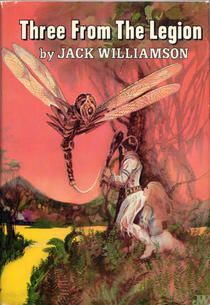
Review: Jack Williamson, Three from the Legion

7/16/2014

0 Comments

 
Picture
I just finished the last of Jack Williamson’s Three from the Legion omnibus yesterday, and today I posted a review at Goodreads:
https://www.goodreads.com/review/show/998322353?book_show_action=false .

Really, each succeeding novel was better than the last, and while the first book was published in 1935, the third dated from 1950, and the final novella tucked in at the end of that was actually 1967, so by the end we were reading much more mature and modern work.

Rafeeq


Having already written a review of The Legion of Space
https://www.goodreads.com/review/show... before realizing that this novel also is collected in Three from the Legion, now I will finish up with the full omnibus trilogy.

Although I had harped on some nagging features of the first Legion novel, the following works in the series struck me as noticeably better, which was a pleasant surprise. Yes, we are still reading space opera from the Golden Age of science fiction, so good is good, and bad is bad, with non-humans such as aliens from outside the Solar System or mad-scientist-created androids being the latter, and the flinty-eyed, usually tall officers of the mighty Legion of Space guarding the former. Fair enough for the genre. Still, the characters and the points of view brought by these succeeding books pull a series that began for me in the two-to-three star region into the neighborhood of more like four stars.

Whereas John Star of The Legion of Space (1935) does not seem very well developed, even for the 1930s, his son, Bob Star, the protagonist of The Cometeers (1936), is more conflicted, more human, and hence more interesting. Bob is young and very capable, but he is less sure of himself than was his father at that age, and secretly vulnerable. In striving to beat the grades of the number-one student at the Academy, an upperclassman who has it out for Bob and hazes him mercilessly, the boy has worked himself to the edge of a nervous breakdown. Now after graduation his parents have tried to keep him at home, shielded from the peculiar news brewing at the edge of the Solar System, so that he might rest up before receiving his first space assignment. Such treatment galls...and the throbbing beneath the scar on his forehead, a reminder of the torture--literal torture--of rival Stephen Orco never goes away either. Still, when a strange green comet-like object sails in from interstellar space like a dreadnought, the youngster at last will have the chance to prove himself--oh, yes, and save the Solar System and find himself a girlfriend, too.

When Williamson revisits the series almost a decade and a half later in One against the Legion (1950), the protagonist is another firm-jawed young officer aching for his first assignment, only here the youngster is framed for murder and the theft of a top-secret device, and he is imprisoned, convicted as a traitor, and even tortured by Legion interrogators before finally escaping. This time, therefore, the once-infallible Legion of Space is fallible indeed, and as the deeply wronged Chan Derron tries to find out why a super-criminal calling himself the Basilisk is framing him for crime after crime, he will have to get to the bottom of another threat to all humanity.

Finally, although Nowhere Near (1967) is listed as being part of One against the Legion, it is a completely separate novella, taking place years after and light years away from the previous tales. This one is told in first-person point of view rather the sometimes-pompous third person, and it is...well, let us say a decade and a half more sophisticated. Cosmological speculations on the age of the universe and whatnot happen to be rather dated now, but the piece is so much more modern and subtle than even the 1950 book. The narrator, the commander of a space station near a strange spacetime anomaly, is experienced and a little weary, and he is not immediately swept to breathless admiration by the waddling entrance of the Giles Habibula, the now-famous gourmand/lockpick/incipient alky of the previous novels, nor even by the flourishing of the name of the distinguished Star family. And when some grizzled-veteran-meets-girl occurs, even that is made almost tolerable by its less cliched execution.

While the first installment of the Legion of Space saga does not age especially well, the following works get better and better, slowly shedding their histrionics across the decades, and even growing quite palatable indeed. I only wish Williamson had not begun the series with a "found manuscript" narrative frame that he then seems to forget and never close...

16 July 2014

0 Comments

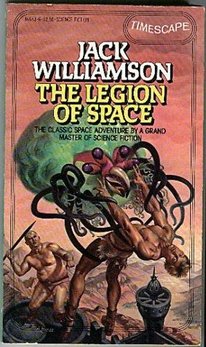
Review: Jack Williamson, The Legion of Space

7/14/2014

0 Comments

 
Picture
Oops, just realized that although about a week ago I did a review of Jack Williamson’s old The Legion of Space on Goodreads
https://www.goodreads.com/review/show/988149834?book_show_action=false, I apparently forgot to cross-post it to my blog, which is a tad sloppy.  Therefore, now that I am almost done with the final book in the trilogy, and hence on the verge of posting another review, here, belatedly, comes this ’un.

Rafeeq


Jack Williamson's The Legion of Space is an interesting artifact the Golden Age of science fiction, copyrighted in 1935 and then tweaked after the war with its twentieth-century narrative frame now mentioning Pearl Harbor. It is definitely an acquired taste, though. If this novel were the work of a modern author...well, the thing simply would not be publishable, as if Norman Spinrad's The Iron Dream, by Adolf Hitler had been stripped of irony and self-awareness; call that, at most, one star. From the perspective of the mid-1930s, though, presumably it would be a four- or perhaps five-star book...in the category of "science fiction space opera," of course. For a science fiction buff whose readings have included the old stuff, let us call it now two or three stars, rounding up on general principle.

The story is pure adventure, at a breakneck pace, with short little chapters ending with a cliffhanger. I do not fault it for that--such is the genre, and even quaint oddities such as future fortresses with medieval-style walls, alien jails whose completely mechanical locks can be picked by Earthlings, awe-inspiring buildings whose dimensions usually come in increments of thousands of feet, and whatnot do not detract too much. The voice of the narrative, however, is a little harder to swallow: a simple third-person point of view that is big on superlative descriptors of the external world while dipping into the inner mind of the protagonist somewhat perfunctorily. Again, though, that is the 1930s.

What grated a bit for me was the utter simpleness of worldview. Good is good, and bad is bad, and while there may indeed be truth in that, too often such things were just painfully obvious. The man who would overthrow democracy and reinstate a monarchy, with himself as Emperor of the Sun, for example, seems a baddie from the moment he steps onstage, wearing makeup bold enough to be read even by viewers in the last row. This distant relative of the protagonist is effeminate and haughty, possessed of "insolent pride" and a "[r]etreating chin and irresolute mouth betray[ing] the man's fatal weakness"--all of this given in five ex cathedra lines predating by three decades the "Show; don't tell" admonition of countless creative writing professors. When the protagonist ignores his shiver of unease and instead tells himself that he should not doubt this superior officer of the Legion of Space--who is attended, by the way, by one trooper described as ratlike and another described as wolfish--this gives us less complexity than an awkward and cringe-worthy moment. How, after all, did he miss the urgent piano music and the mustachios being twirled?

The giant jellywish-like alien invaders are evil, as apparently can be apprehended at first glance. The "girl" who guards the secret of the ultimate weapon that has kept the peace of the Solar System is slim and beautiful, and naturally the protagonist falls--without, of course, ever consciously putting a name on it until the end--in love with her at their first meeting. One of his companions-to-be is a calm and quiet-voiced leader, one is hugely muscled, and one is an obese gourmand goldbrick always bemoaning, comic-relief-wise, his pathetic fate, and calling for another meal, another nap, or another bottle of wine...oh, yes, but he happens to be a top-notch locksmith and spaceship engineman, too. Even the protagonist's other distant relative, the one who arranged for the square-jawed fellow to serve under the baddie, is precisely what he seems, right down to the redeeming qualities that were obvious even when he seemed a traitor to all that was good and right.

Such carping out of the way, however, The Legion of Space is at least a decent book, so long as the reader understands that it comes from an era almost 80 years removed, from the heyday of pulp fiction. It is fun--it really is--if approached in the right frame of mind.

6 July 2014

0 Comments

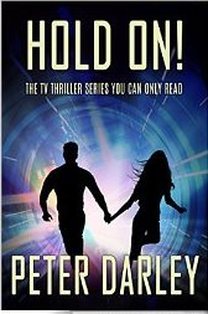
Review: Peter Darley, Hold On!

7/13/2014

0 Comments

 
Picture
I just finished Hold On! by Peter Darley—an entertaining combination of thriller and romance.  I had read an earlier draft last year, but I still tore through this final version with pleasure, as it truly was hard to put down.  Chapters are short, so it‘s always easy to go ahead and read the next one, and the gajillion cliffhangers make you want to do that anyway.

Below, therefore, is a review I did at Goodreads:  
https://www.goodreads.com/review/show/995034110?book_show_action=false

Rafeeq


Hold On! by Peter Darley is a fun, fast-paced guilty-pleasure read: a roller-coaster thriller of government conspiracy, murderous cover-ups, and cliffhangers, all underlaid with a burgeoning romance between the dashing hero and the damsel he rescues, plus the nagging enigma of the man's mysterious past.

Brandon Drake, grievously wounded saving a fellow soldier in Afghanistan, was sent Stateside and somehow put back together again, but while serving in a military research laboratory he uncovers a terrible secret, and now he has gone AWOL to stop a false-flag terror operation that has already killed dozens, and threatens to serve as the pretext for another war. Belinda Reese, the lonely woman whom Drake rescues from certain death, is captivated by the lone warrior's courage and his good looks, and also by his surprising shyness. On the run from the hired killers directed by a rogue government official, they must struggle to keep their love, their freedom, even their lives.

Really, the plot cannot be summarized much further, for there occur so many twists and turns that spoilers abound. Suffice it to say, then, that there are spy gadgets, disguises, villains, breakneck chases, and hairbreadth escapes. In addition to all the intrigue and action, though, the novel also explores the nature of love, the meaning of duty, and even, on something of a philosophical level, the construction of "self."

Hold On! is an entertaining thriller-romance. It is by turns deadly serious, touching, sometimes even a little silly. The book was very hard to put down, though, and that is a great strength.

13 July 2014

0 Comments

Review: Algis Budrys, Who?

7/8/2014

1 Comment

 
Picture
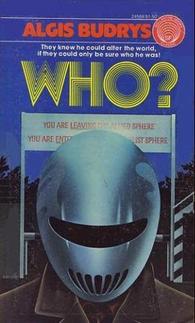
I confess that for some reason, when I was young, whenever I happened to see Who? by Algis Budrys in the bookstore, I was rather put off by what struck me as a cheesy and uninspiring cover...  Ah, nyetculturni youth!  Well, I’ve read ’er now, and I'm glad I did—an absolute joy of a read.

Here is a small review I did at Goodreads a few days ago:
https://www.goodreads.com/review/show/986810102?book_show_action=false.

Rafeeq


Algis Budrys' 1958 Who? is an exquisite science fiction novel evoking the height of the Cold War, when the Iron Curtain was still almost impenetrable, and tit-for-tat incidents were escalated both as signals of military resolve and for propaganda value at home and abroad.

When the laboratory of American scientist Lucas Martino, who spearheaded the ultra-secret K-88 project, explodes near the East-West border in Europe, Soviet "rescue" teams reach the maimed survivor first. Yet who is the reconstructed, metal-faced man who eventually returns? Is it Martino or an enemy agent with the scientist's arm and hence correct fingerprints grafted on? Even if it is Martino, is he still loyal, or has he switched sides or even merely accidentally let some crucial piece of information slip? Can the all-important K-88 project be completed, or as something presumably compromised, must it be abandoned? And, in fact, what is K-88 anyway? Certainly it is important, but even Martino's Soviet interrogator has no clue as to whether it is "a bomb, a death ray, or a new means of sharpening bayonets," nor do the American security personnel who investigate the returnee. Whatever K-88 is, though, its price--in money, effort, and lives--is very, very high.

Who? thus piles question upon question upon question. Yet while the 1950s-style Cold War machinations are gripping, the novel is no mere rah-rah gung-ho. Yes, the Western side is presumed to be at least basically morally superior to the Soviet police state, a judgment that still seems correct. But as Budrys explores, very probingly, the "security" mindset and the paranoia inherent when two ideologies compete for control of the entire world, he also examines the precariousness of identity that, really, is always with us. Tense, thoughtful, and melancholy, Who? is a beautifully rendered tale of great sophistication.

5 July 2014

1 Comment

Review: Frederik Pohl, Planets Three

7/6/2014

0 Comments

 
Picture
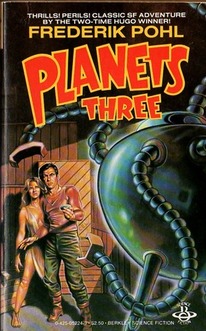
After having read Pohl and Williamson’s Undersea Quest and Undersea Fleet, I was in a Fred Pohl sort of mood, so I read Planets Three, a collection of three of his novellas written shortly after the Second World War.  The cover, after all, despite some real problems with the execution of the human faces, was irresistibly “pulpy,” and it even turned out to depict a scene within, which I always like.

Here is the review I did at Goodreads a few days ago: 
https://www.goodreads.com/review/show/986232680?book_show_action=false.

Rafeeq


Planets Three is a collection of three Frederik Pohl novellas originally published in the early postwar period under his "James MacCreigh" pseudonym: Figurehead, wherein three humans are taken by aliens to their native Ganymede for study and experimentation; Red Moon of Danger, set in a mysteriously accident-plagued uranium mine on the Moon; and Donovan Had a Dream, which shows political and military intrigue on a Venus dominated by a quasi-religious/scientific sect of human women.

All of the novellas are decent, though I confess that sometimes--especially in Figurehead--I caught myself forgetting that these works came not from the mid-Thirties but from significantly later. This first piece, while still entertaining, is perhaps the weakest of the three; the first-person narrative is glib and rather wisecracking, but it seems a little superficial, as if, despite a very nice "sense of wonder" moment when enormous Jupiter is first seen rising on the sky, the characters are simply running through an escape story that could have taken place in a pulp crime magazine instead of SF. By POV and predicament I was reminded somewhat of Eric Frank Russell's "Symbiotica," anthologized in Healy and MacComas's 1946 Adventures in Time and Space, but I found Figurehead half a notch inferior.

Red Moon of Danger is simple but decently fun bare-knuckled adventure, and although the source of the cave-ins and accidents is nicely played, I wish the villain directing them were not so damned transparent and obvious in his villainy. The rather unfortunately titled Donovan Had a Dream is likely the best of these three, and while even it may creak just a little bit here and there, we must remember that it was written comparatively early in the history of modern SF, and that we have seen 60-odd years of succeeding print, film, and television schlock make cliches of things that once were new. Like the other works, this one ends with a man of action getting "his girl"; none of these females, however, needs rescuing by someone in lace-up engineer's boots and jodhpurs--all have some spunkiness and bravery of their own.

Is this the best that Fred Pohl has written? No... But, at least for someone interested in revisiting the earlier, simpler days of the genre, these novellas are still worth the read.

4 July 2014

0 Comments

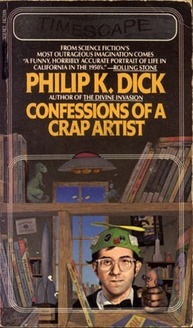
Review: Philip K. Dick, Confessions of a Crap Artist

7/5/2014

0 Comments

 
Picture
Well, I had had Philip K. Dick’s Confessions of a Crap Artist sitting on the shelf, picked up at Curious Books in East Lansing a few months ago, and while I had read all of Dick s other works back in the late ’80s and ’90s, it was only a few days ago that I finally got around to reading this one—intriguing and enjoyable, and, really, it rather whets the palate for going back and rereading all the other works sometime...

In any event, I did a quick review on Goodreads
https://www.goodreads.com/review/show/985909012?book_show_action=false, so here ’tis.

Rafeeq


Deeply intriguing, sometimes puzzling, definitely worth the read. Point of view is interesting, varying among first person with Jack, and third person limited with either Fay or Charley or Nat. Toward the end Jack comments on the various levels of irony in the title of his book--is he presumed to have written all other chapters as well, rather than there being an omniscient author who compiled everything? Maybe, maybe not, though the lurid pulp-style "dramatization" of the affair of Fay and Nat which he presents to Charley in the hospital makes me wonder.

And I wonder about a few loose ends, too. In one chapter, for example, Jack says that his parents burned his comic book collection during the war while he was fighting on Okinawa, while later Fay notes, perhaps a bit derisively, that he was in the service only a few months--what exactly is the truth here? Or what of Jack's early mention of his interest in, essentially, bondage or fetish erotica, which never seems to come back, unless it is with the faint echo of the lurid pulps he imitates? How much does Jack really know, and who is kidding whom? Such questions, perhaps, are part of the novel's appeal.

4 July 2014

0 Comments

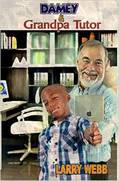
Review: Damey & Grandpa Tutor by Larry Webb

6/28/2014

0 Comments

 
Picture
I had asked for a review copy of Damey & Grandpa Tutor by fellow Michigan author Larry Webb, and the piece came today.  It was gentle and engaging, and somewhat to my surprise, I sat down and read the entire thing in an afternoon and evening.  On Goodreads, therefore, I posted a review: https://www.goodreads.com/review/show/980617335.  If you want what I believe once was called the “ashcan school” of literature, this ain’t it, but if you want a good-natured story of well-meaning adults trying to make their world a better place...then this one is for you.

Rafeeq

0 Comments
Forward>>

    Author

    Author of several dozen pieces of literary criticism, reference entries, and reviews; novel Student Body; memoir Tiger Hunts, Thunder Bay, and Treasure Chests; how-to The Bibliophile's Personal Library; humorous Have You Ever Been to an Irishman's Shanty?​; some poetry; and quite a bit of advising/Banner training materials.

    Archives

    May 2025
    August 2024
    May 2024
    November 2023
    November 2022
    October 2022
    September 2022
    January 2022
    December 2021
    July 2021
    July 2020
    June 2020
    May 2020
    February 2020
    September 2019
    March 2019
    January 2019
    December 2018
    November 2018
    August 2018
    June 2018
    November 2017
    July 2017
    June 2017
    May 2017
    April 2017
    March 2017
    February 2017
    January 2017
    December 2016
    November 2016
    July 2016
    May 2016
    February 2016
    January 2016
    December 2015
    November 2015
    October 2015
    September 2015
    August 2015
    July 2015
    May 2015
    April 2015
    March 2015
    February 2015
    January 2015
    December 2014
    November 2014
    October 2014
    September 2014
    August 2014
    July 2014
    June 2014
    May 2014
    April 2014
    March 2014
    February 2014
    January 2014
    December 2013
    October 2013
    August 2013
    July 2013
    May 2013
    April 2013
    March 2013
    February 2013

    Categories

    All
    A.J. Donnell
    Anthony Boucher
    Astounding Science Fiction
    Book Review
    Chesley Bonestell
    Clifford Geary
    Curious Books
    Darrell K. Sweet
    Edd Cartier
    Ed Emshwiller
    Fahrenheit 451
    Fred Freeman
    Goodreads
    Hal Clement
    Hannes Bok
    Hubert Rogers
    Jack Coggins
    Jack Finney
    Jim Burns Art
    Kelly Freas
    Larry Webb
    Lester Del Rey
    Michigan Transfer Agreement
    Philip K. Dick
    Pulp SF
    Ray Bradbury
    Reading Place Charlotte
    Reading Place-Charlotte
    Richard M. Powers
    Robert A. Heinlein
    Rolf Klep
    Salem Press
    Salem Press
    Schuler Books
    Scribner's
    SF Art
    Steele Savage
    Student Body
    Vincent Di Fate
    Virgil Finlay

    RSS Feed

Powered by Create your own unique website with customizable templates.